Text Size
Details Written by Dr. Brian Hatten on November 17, 2026
UNCATEGORISED

Literature

Dr. Brian Hatten
Written By Dr. Brian Hatten
Revised November 17, 2026
Resources

My Knee Guide in
the Literature

My Knee Guide has been studied or cited in 12 peer reviewed studies across four continents, including an NIH funded randomized control trial selecting My Knee Guide as the clinical baseline.

Research Study

NIH-Funded Randomized Controlled Trial

University of South Carolina & Northwestern University (2021) | Contemporary Clinical Trials Communications

Researchers at the University of South Carolina and Northwestern University selected My Knee Guide to serve as the "standard of care" control group for an NIH-funded randomized controlled trial.

The study, titled "Reducing sedentary time using an innovative mHealth intervention among patients with total knee replacement," utilized the platform as the benchmark for evaluating new mobile health interventions.

In the peer-reviewed protocol, My Knee Guide is characterized as a comprehensive digital platform specifically designed to facilitate pre- and post-operative education, as well as essential appointment tracking.

All participants downloaded the MyKneeGuide® app during enrollment, underscoring the researchers' confidence in the platform as the clinical baseline.

By utilizing the app in this capacity within a federally funded study, the research underscores the platform's reliability and its role as an established resource for patient care in the field of orthopedic surgery.

Systematic Review of Smartphone App Quality – #1 Ranked

Bournemouth University, United Kingdom (2018) | Disability and Rehabilitation

In their systematic review, Smartphone apps for total hip replacement and total knee replacement surgery patients: a systematic review, published in Disability and Rehabilitation, researchers at Bournemouth University's Orthopaedic Research Institute conducted the most comprehensive quality assessment of smartphone applications designed for hip and knee replacement patients.

Three independent reviewers screened 2,613 applications across five major app stores and identified fifteen that met inclusion criteria.

Each app was evaluated using the Mobile App Rating Scale (MARS), a validated 19-item instrument that measures engagement, functionality, aesthetics, and information quality.

My Knee Guide achieved the highest overall MARS quality score of any evaluated app (4.23 out of 5.0), ranking first out of fifteen.

The platform earned the highest engagement score (4.80 vs. mean 2.81) and led all four subscales, including functionality, aesthetics, and information quality.

The inter-rater reliability among reviewers was exceptionally high, confirming the objectivity of the evaluation.

This independent, peer-reviewed ranking validates My Knee Guide as the highest-quality patient education app in the field of joint replacement surgery.

Research Study
Systematic Review of Smartphone App Readability

Systematic Review of Smartphone App Readability

Bournemouth University, United Kingdom (2020) | Journal of Patient Experience

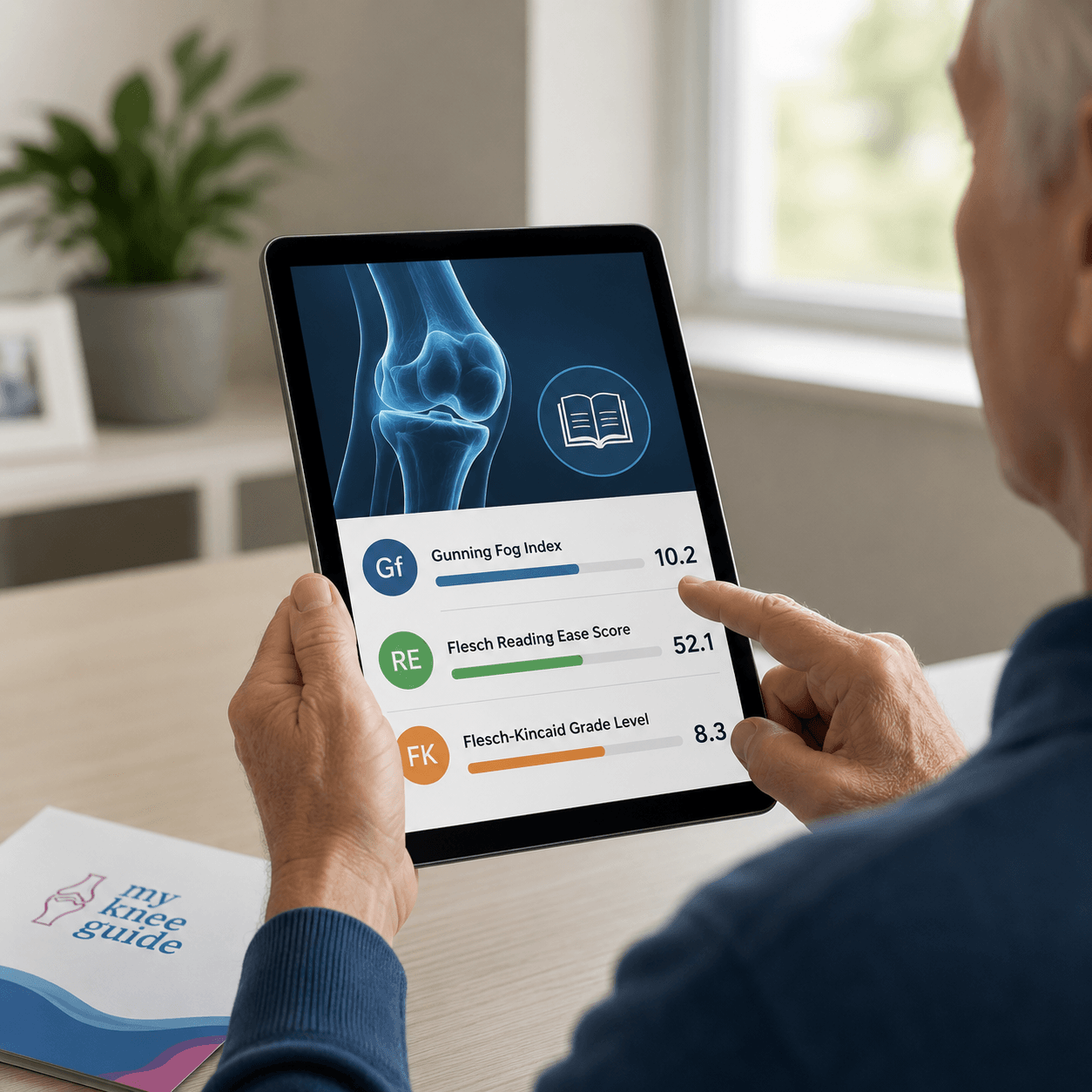
In a companion systematic review, Readability of Information on Smartphone Apps for Total Hip Replacement and Total Knee Replacement Surgery Patients, published by the Orthopaedic Research Institute at Bournemouth University, the same research team evaluated the same fifteen smartphone applications—this time focusing on how accessible the medical information is to patients.

The study utilized three validated readability metrics—the Gunning Fog Index, the Flesch Reading Ease Score, and the Flesch-Kincaid Grade Level—to audit the literacy demands of each platform.

The study found that nearly all orthopedic apps in the category, including My Knee Guide, provide information at a reading level above the recommended sixth-grade threshold.

The authors emphasized the need for app developers to engage patients in the design process to improve readability and enhance the patient experience.

Together with the quality assessment above, these two independent studies from the same research institute provide a comprehensive, peer-reviewed evaluation of My Knee Guide across both quality and readability dimensions.

Peer-Endorsed Digital Health Curation

UC San Diego, Harbor-UCLA Medical Center & University of Washington (2015) | Orthopedic Research and Reviews

Faculty at three major academic medical centers conducted a comprehensive evaluation of mobile applications in their study, Mobile apps for orthopedic surgeons: how useful are they? published in Orthopedic Research and Reviews.

The study evaluated 170 orthopedic applications and selected just 39 for inclusion—a highly selective curation process.

The authors, affiliated with UC San Diego, Harbor-UCLA Medical Center, and the University of Washington, personally vetted each platform for clinical value and reliability.

My Knee Guide was designated a "Top" resource, a distinction reserved for digital tools that demonstrate exceptional quality for patient education.

In the accompanying clinical review, co-author Dr. John Andrawis, an orthopedic surgeon at Harbor-UCLA, wrote that he was "extremely impressed with how this app personalizes the experience of knee replacement surgery to the patient," specifically highlighting the platform's day-by-day surgery guide and creative use of real-world patient stories.

"This is an app I plan to use with my patients to help them learn more about total knee replacement."
— Dr. John Andrawis, Orthopedic Surgeon, Harbor-UCLA Medical Center

Peer-Endorsed Digital Health Curation
Systematic Review of Website Quality and Readability

Systematic Review of Website Quality and Readability

University Hospital Galway, Ireland & Fiona Stanley Hospital, Australia (2019) | F1000Research

An international research team from Ireland and Australia published Anaesthesia for total hip and knee replacement: A review of patient education materials available online in F1000Research, a study that reviewed the quality and readability of online patient education materials available to patients preparing for hip and knee replacement surgery, including information related to anaesthesia.

The researchers evaluated thirty-two global websites using validated tools, including the DISCERN instrument, readability indices, and quality certification standards, to measure information quality and patient readability.

My Knee Guide was among the select group of platforms evaluated by the researchers.

Notably, the study identified My Knee Guide as one of only eight websites (25%) maintaining HONcode certification, an international benchmark for providing trustworthy, ethical, and transparent health information.

By including the platform in this peer-reviewed evaluation and noting its quality certification, the study validates My Knee Guide as a significant resource in the international orthopedic landscape that adheres to established transparency standards for ethical health reporting.

Clinical Guidance for Return to Athletic Activity

Kerlan-Jobe Orthopaedic Clinic, Los Angeles (2017) | American Journal of Sports Medicine

Clinicians at the world-renowned Kerlan-Jobe Orthopaedic Clinic in Los Angeles included My Knee Guide as a featured resource in their clinical guidance for patients returning to athletic activity.

The study, titled Return to Golfing Activity After Joint Arthroplasty, was authored by leading physicians affiliated with the Keck School of Medicine at the University of Southern California who specialize in treating elite athletes.

The researchers performed a systematic review of the medical literature alongside a web-based search evaluating clinical practice recommendations, identifying My Knee Guide as a specific, evidence-based platform to help surgeons and physical therapists counsel patients on the biomechanics and timing of returning to golf following surgery.

By recommending the platform within the premier journal for sports medicine, the authors validate My Knee Guide as a high-level educational tool capable of supporting the specialized needs of active patients.

Clinical Guidance for Return to Athletic Activity
Foundational Literature for Post-Operative Rehabilitation

Foundational Literature for Post-Operative Rehabilitation

Paracelsus Medical University, Austria & Bielefeld University, Germany (2020) | BMC Musculoskeletal Disorders

Researchers at the Paracelsus Medical University in Salzburg, Austria, and Bielefeld University in Germany utilized My Knee Guide as foundational background literature for their study, RECOVER-E: a mobile app for patients undergoing total knee or hip replacement: study protocol, published in BMC Musculoskeletal Disorders.

This clinical research focused on developing and evaluating an evidence-based mobile application for patients undergoing hip or knee replacement across four German hospitals.

By citing My Knee Guide in the study's background as a representative resource for existing patient education platforms, the international research team acknowledged the platform's role in providing structured, patient-facing information.

The inclusion of My Knee Guide in this multi-center study design demonstrates its utility as a peer-referenced tool for clinicians developing modern, evidence-based recovery protocols for joint replacement patients.

Global Compendium of Online Orthopedic Resources

All India Institute of Medical Sciences (AIIMS), Rishikesh, India (2021) | International Orthopaedics

Faculty at the All India Institute of Medical Sciences (AIIMS) in Rishikesh, India, included My Knee Guide in their study, Online educational resources for orthopaedic residency: a narrative review, published in International Orthopaedics.

The review curated a highly selective compendium of the most valuable online educational tools available in the field—spanning 16 websites, 39 smartphone apps, 9 podcasts, and 11 YouTube channels.

The corresponding author, a senior faculty member with years of teaching experience in postgraduate and fellowship training programs, personally selected the final list.

My Knee Guide was featured among the 39 curated apps as a premier patient education platform for total knee replacement.

By being featured in this international peer-reviewed compendium, the platform is validated as a globally relevant tool that meets the rigorous standards of academic faculty across diverse healthcare systems.

Global Compendium of Online Orthopedic Resources
Government-Endorsed Clinical Review

Government-Endorsed Clinical Review

Healthify He Puna Waiora – New Zealand Health App Library (2024)

A licensed physiotherapist conducted a structured clinical review of My Knee Guide as part of the New Zealand Health App Library, an independent app evaluation service operated by the Health Navigator Charitable Trust and supported by Health New Zealand – Te Whatu Ora, the country's national healthcare system.

The review process was developed in partnership with ORCHA (Organisation for the Review of Care and Health Apps), the global leader in digital health app assessment and accreditation, whose frameworks are used across twelve countries including within 70% of NHS sites in England.

The reviewing platform, Healthify He Puna Waiora, is itself endorsed by the Royal New Zealand College of General Practitioners (RNZCGP), which represents approximately 90% of all general practitioners in New Zealand.

Following a structured evaluation of clinical utility, educational content quality, and patient safety, the reviewer awarded My Knee Guide a four-star rating and described it as "a comprehensive app for knee surgery patients" that "creates a portal for patients to gain oversight into the process of all facets of their knee surgical journey."

The reviewer specifically noted the platform's value as a personalized educational resource hub offering tools to navigate pre-operative, post-operative, and rehabilitation phases.

Although the app was developed for a US audience, the review affirms its relevance to New Zealand patients as an educational tool. This independent, clinician-conducted evaluation within a government-supported health infrastructure validates My Knee Guide's utility and quality for an international patient population.

Reference Source in Biomechanical Engineering Research

University of La Rioja, Spain (2018) | International Journal on Interactive Design and Manufacturing

Researchers in the Mechanical Engineering Department at the University of La Rioja in Logroño, Spain, cited My Knee Guide as a reference source in their original research paper, The process of designing a rotating platform artificial knee prosthesis with posterior stabilizers by finite element analysis, published in the International Journal on Interactive Design and Manufacturing.

The study applied reverse engineering, 3D scanning, and the finite element method to design a rotating platform knee prosthesis with posterior stabilizers, then compared stresses on the cortical and trabecular bone of both a healthy knee model and the artificial prosthesis model.

In their discussion of knee implant types, the authors cited My Knee Guide among their authoritative references for the framework that classifies knee replacement components by how the polyethylene insert attaches to the underlying tibial component, distinguishing fixed bearing designs from rotating platform designs.

By drawing on the platform in a peer-reviewed biomechanical engineering study, the research extends My Knee Guide's role beyond clinical and patient education contexts into the engineering literature that informs how next-generation knee implants are designed and evaluated.

Reference Source in Biomechanical Engineering Research
Clinical Review of Postoperative Pain Management Apps

Clinical Review of Postoperative Pain Management Apps

Hogrefe AG, Switzerland (2019) | Schmerz und Schmerzmanagement

In his clinical review of smartphone applications for postoperative pain management following knee and hip arthroplasty, Smartphone-Apps im postoperativen Schmerzmanagement bei Knie- und Hüftendoprothese: Eine Übersicht des gegenwärtigen Angebots, author David Bruns cited My Knee Guide in his survey of mobile health tools available to joint replacement patients.

The review, published in the Hogrefe journal Schmerz und Schmerzmanagement (Pain and Pain Management), examined how mobile apps support preoperative education, postoperative pain assessment, and patient self-management in the days before and after surgery.

Bruns cited My Knee Guide in his discussion of how apps provide perioperative pain management information to patients undergoing knee arthroplasty, referencing the platform's coverage of standard clinical approaches to postoperative analgesia.

By featuring the platform in a peer-reviewed German-language clinical review, the article extends My Knee Guide's recognition into the German-speaking medical community as a reference resource for orthopedic patient education.

Finite Element Analysis Validating Mobile Bearing Cruciate Retaining Prosthesis Choice

University of Liège, Belgium (2021) | Master's thesis, School of Engineering and Computer Science

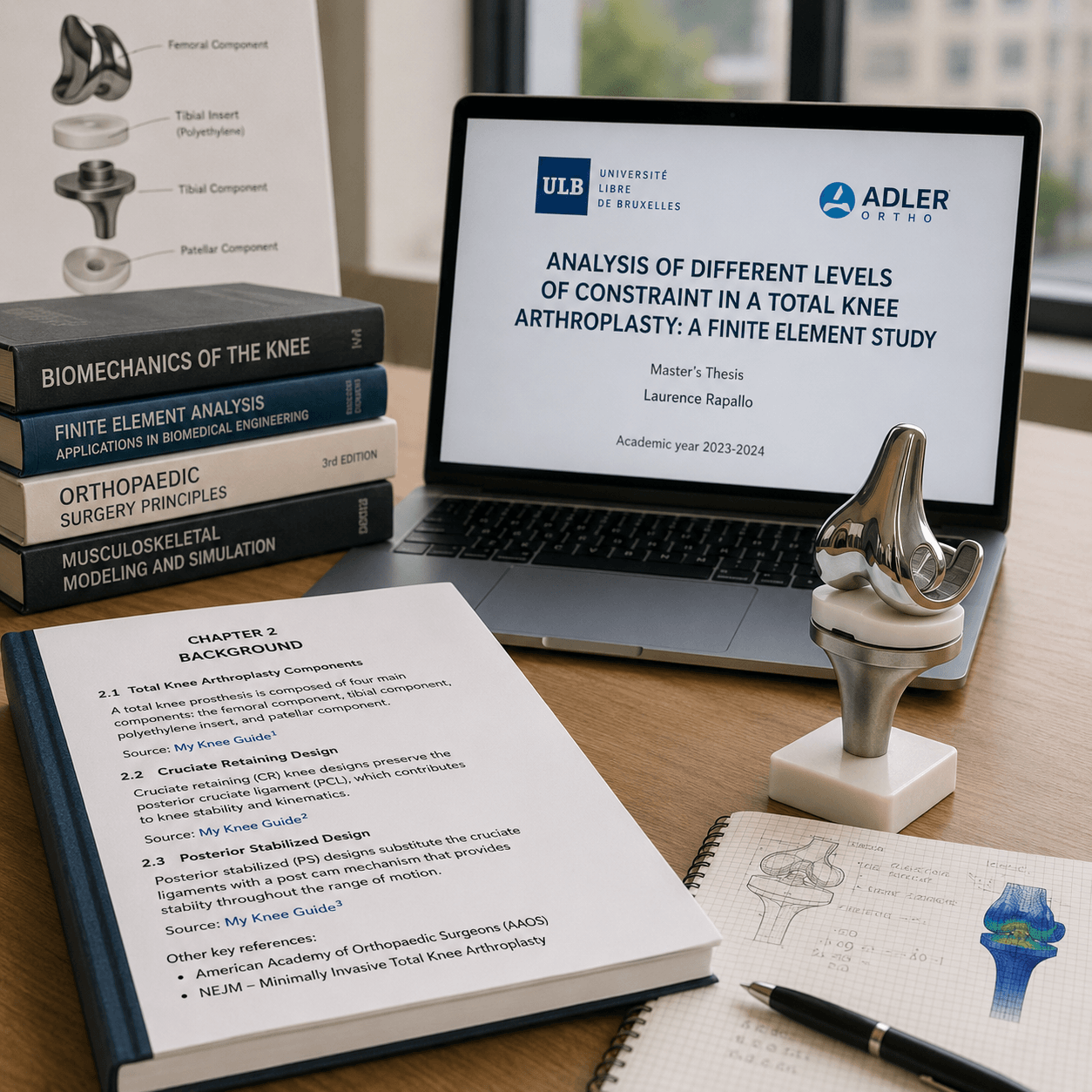
This master's thesis by Laurence Rapallo, conducted in collaboration with Université Libre de Bruxelles and the Italian orthopedic company Adler Ortho, cites My Knee Guide three times as a foundational reference within its background chapter on total knee arthroplasty.

The thesis draws on My Knee Guide's explanation of the four components that make up a knee prosthesis, its description of cruciate retaining knee designs and how they preserve the posterior cruciate ligament, and its discussion of posterior stabilized knee designs and the post cam mechanism that replaces the cruciate ligaments.

My Knee Guide is referenced alongside the American Academy of Orthopaedic Surgeons and a New England Journal of Medicine article on minimally invasive total knee arthroplasty, placing the site among the core educational sources the author selected to establish foundational concepts for her engineering analysis.

The thesis itself, Analysis of Different Levels of Constraint in a Total Knee Arthroplasty: A Finite Element Study, used finite element modeling to confirm that a mobile bearing cruciate retaining prosthesis was the optimal implant choice for the specific patient studied.

Finite Element Analysis Validating Mobile Bearing Cruciate Retaining Prosthesis Choice